
News & Insights
2026年1月29日
How to Choose the Right PCR Machine: The Ultimate 2026 Buyer’s Guide for Labs
Looking for the best PCR machine? Read our 2026 expert guide on choosing a thermal cycler, covering ramp rates, uniformity, and clinical compliance for labs.
In the world of molecular biology, the PCR machine (thermal cycler) is the heartbeat of the laboratory. Whether you are running routine diagnostics, conducting advanced genomic research, or setting up a new IVD production line, choosing the right instrument is critical to your success.
With technology advancing rapidly in 2026, simply looking at the price tag is no longer enough. This guide breaks down the essential factors you must consider to ensure your lab’s efficiency and accuracy.
1. Understanding Your Application: Regular, Gradient, or qPCR?
Before diving into specs, identify your primary workflow. Not all PCR machines are created equal:
- Standard PCR: Ideal for routine amplification where the annealing temperature is already optimized.
- Gradient PCR: A "must-have" for R&D labs. It allows you to test multiple temperatures in a single run, helping you find the perfect annealing point for new primers.
- Real-Time PCR (qPCR): Necessary for quantification of DNA/RNA, commonly used in clinical diagnostics and pathogen detection.
2. Key Technical Specs: Beyond the Brochure
When comparing manufacturers, pay close attention to these three performance indicators:
A. Ramp Rate: Speed vs. Stability
The ramp rate (measured in $^\circ\text{C/s}$) defines how fast the block changes temperature. While a high ramp rate (e.g., $5.0$–$6.0^\circ\text{C/s}$) shortens your protocol, it must be balanced with thermal stability to prevent "overshooting" the target temperature, which can ruin sensitive samples.
B. Thermal Uniformity
High uniformity (e.g., $\pm 0.2^\circ\text{C}$ at $95^\circ\text{C}$) ensures that every well in your 96-well plate yields the same result. Without this, you risk "edge effects" where samples on the perimeter of the block behave differently than those in the center.
C. Block Flexibility
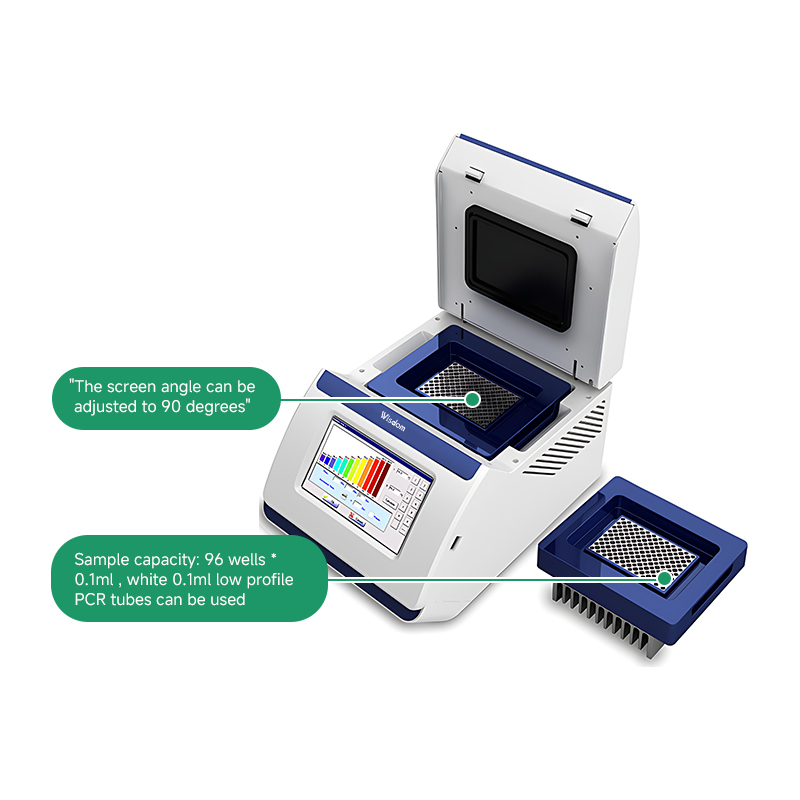
Does your lab use 0.2ml tubes, 96-well plates, or 384-well plates? Look for instruments with interchangeable blocks to future-proof your investment.
3. The Hidden Cost: Maintenance and Compliance
For hospital labs and IVD factories, the purchase price is just the beginning.
- Regulatory Compliance: Ensure the device is CE-IVD or ISO 13485 certified if used for medical diagnosis.
- Calibration Services: Does the manufacturer provide NIST-traceable calibration?
- Energy Efficiency: Modern labs are moving toward "Green Lab" certifications. Energy-efficient cooling systems can save thousands in electricity costs over the machine’s lifespan.
4. Troubleshooting Common PCR Issues
Why are my results inconsistent? Often, the culprit is a dirty thermal block or a worn-out heated lid. A high-quality PCR machine should feature a pressure-adjustable heated lid to prevent sample evaporation, which is the #1 cause of PCR failure.
Summary Checklist for 2026 Buyers
- [ ] Does it offer a Gradient function for protocol optimization?
- [ ] Is the software intuitive and "Touch-Screen" friendly?
- [ ] What is the manufacturer’s guaranteed response time for repairs?
- [ ] Does the footprint fit your lab bench space?
Conclusion
Investing in a PCR machine is an investment in your data's integrity. By focusing on thermal uniformity, ramp rate stability, and long-term support, you ensure that your lab remains productive and reliable.
Looking for a high-performance Thermal Cycler for your lab? [Explore our latest PCR Series here] or [Contact our Technical Specialists for a Quote].